Sunday, February 24, 2019

New Book: Seeker: a Sea Odyssey by Rita Pomade


Available at MiroLand here
Rita Pomade ... It was a name attached to an excellent article on amate, a Mexican folk art. I wanted to use the article so I sent a request for permission to the email listed. Thus began a connection which grows more interesting. 

We discovered common friends made when she lived here in Ajijic. She has written a book about her life on a sail boat (an unrequited dream of mine ... next life). And, she experienced the aftermath of 1968, a year I've become fixated on. Throw in the circumstance that I live next door to the summer house of President Diaz Ordaz, the anti-hero of those turbulent late 60s, and it seems like an unlikely flow of coincidences.

Anyway, Rita has offered to share the first chapter of her book, Seeker: A Sea Odyssey, and I'm delighted to be able to make that happen. I asked her to give us an introduction and she offered us a short view of her life and the trauma that changed it. Her story has me riveted and anxious for the book to come out. 

Amazon will release it on May 1 but it is available now at the link under the picture.

From Rita:


Rita at sea
The year I was diagnosed with cancer my marriage ended. I lost my health and partner at the same time, and felt paralyzed with fear. Knowing that I could die triggered a shift in how I viewed life. I realized that to put my life on hold was a loss of the journey I was here to experience.  I saw life as a gift, and that to not use it fully was to not honor the awesomeness of being here. Having broken and mended many times, I came to see each break as letting in more light. One day, I found a short saying in the upper right corner of the front page of my local newspaper. It read “Success is fear but doing it anyway.” I clipped the quote and pinned it above my desk.
            While still undergoing chemotherapy, I pressed the button for the elevator from the 19th floor of my apartment building. The door opened and shut, but not before I saw my tiny neighbor from the floor above being brought down on a gurney in a body bag. I felt that should I die, I didn’t feel like being taken down nineteen floors on a gurney in a body bag. I thought about how I craved earth beneath my feet, and how much I wanted to tear up the sidewalk every time I went out. I remembered how I had once felt earth’s magnetic energy flood my body. I felt the pull of Mexico. 
I lived in Mexico City in the sixties.  I had gone on vacation and stayed seven years, forfeiting my New York apartment to two young men who had sublet it. Though I had to leave Mexico, a part of me never let the country go. Now I wanted to go back. This time, I chose Ajijic with its gentle climate and flowering jacaranda trees. I built a house at the foot of its mountain overlooking Lake Chapala. I loved my home flooded with light, my garden with the light passing through the flowers, the orange tree I planted and from which I plucked fruit every morning. I planted a banana tree, that I discovered wasn’t a tree, and never stopped growing and reproducing to the delight of my neighbors who benefited from its bounty. The soil was rich, the mountain was alive with medicinal plants that my neighbor brought me for their healing properties, and the mountain range across the lake changed colours with the changing light, leaving me transfixed as I watched the changing hues. I wrote for Mexconnect, had a “Dear Rita” column in the Chapala Review, and learned to do lino-cuts from my friend Pat Apt. I didn’t die, but lived fully my years in Ajijic.
And then one day I had to return to Montreal. And it’s here in Montreal that I wrote Seeker: A Sea Odyssey. But the story began in Mexico. In this excerpt from Seeker, I write about the day I made the decision to leave Mexico to begin my journey. I feel privileged to be able to share it with the friends I had made in Ajijic during the years I lived there and with those that have come after me.
Bernard Rita and Lola
CHAPTER 1 – SUCH STUFF AS DREAMS ARE MADE OF…

I have no reason to go, except that I have never been, and knowledge is better than ignorance. What better reason could there be for travelling. – Freya Stark

OCTOBER 1969: MEXICO CITY

A great sense of adventure and curiosity about other cultures brought Bernard and me to Mexico in the mid-sixties from different parts of the world. He was a French geologist hired to find water for the Mexican government. I was a ceramicist in a potter’s studio, a freelance reporter for a magazine called Mexico/This Month, and part-time English as a Foreign Language teacher. On weekends, I read palms - a skill I had learned through reading books. Having walked away from an abusive marriage, I was trying to support my two young sons in a foreign country. Both of us were dreamers and open to new experiences. It was inevitable that our meeting would spark unexpected possibilities.

We met at the home of Leonora Carrington, a well-known surrealist painter who was as famous for helping to smuggle her then lover, Max Ernst, out of Nazi Germany as she was for her artwork. Leonora had a weakness for handsome young men, and Bernard filled the criteria with his rugged features, alert green eyes, and irreverently coifed head of thick, dark auburn hair. He was tall and lithe – the perfect escort for the parties Leonora used to attend at Diego Rivera’s home. They weren’t lovers, but it pleased her that others thought they were, since he was a good thirty years younger. Bernard, a young underpaid Cooperant (the French equivalent of a Peace Corp worker), took full advantage of the arty parties, replete with free food and flowing booze. I viewed him as a lightweight rake, and made a point of ignoring his overtures of friendship during Leonora’s ‘by invitation only’ Sunday salons.

But all that changed one afternoon when we bumped into each other at the La Merced Market in downtown Mexico City on a miserably hot day. 

“Feel like a beer?” he asked, after the obligatory cliché of “fancy meeting you here.”

“Why not?” I answered.

Over a generous plate of sopes, thick rounds of corn masa slathered with beans, cream, and salsa, and cold bottles of San Miguel beer, we talked about Mexico. We discovered that we shared a love for this vibrant country with its diverse indigenous cultures still intact, its extraordinary shifts of landscape, and its warm and gracious people. But suddenly I started to speak about how the heart had been ripped out of it the year before.

I came to Mexico in 1966. It was a time of tremendous creative output in all the arts. Many Latin American writers and painters, in exile from their own countries or by choice, had settled in Mexico. It brought other intellectuals from all over the world who were caught by the creative energy that defined the country. I planned on being there for a summer vacation, but I sublet my apartment in New York, and decided never to return. Bernard came at the end of 1968.  He arrived in Mexico City a month after the horrific massacre of hundreds of students in the Plaza of the Three Cultures just weeks before the Mexican Olympics. 

It was now 1969 but the repressive measures of the Diaz Ordaz government had not abated. Many of the foreign intelligentsia were accused of instigating the students and were deported. The unlucky ones were jailed and tortured. Others left the country of their own accord. I witnessed students taken from their homes without just cause never to be heard from again, while the secret police roamed the streets with walkie-talkies to report any sightings of “suspicious” young people. Several teenagers hid in my home until they were able to procure forged passports to leave the country. Fear replaced open dialogue and the dynamic euphoria that had marked the city evaporated overnight.  

Paralyzed by depression brought on by the horror of what had happened in a country I loved, I couldn’t leave. I didn’t realise how traumatized I was until I related the story to Bernard. I was looking for something I could hold on to that made me feel alive again. I remembered my childhood when my life was alive with the belief that I could make whatever I wanted come true. We spoke about our childhood dreams.

 Bernard related a half-buried dream of his. It began with his boyhood on the Loire in France, where he had built his own raft to sail the famous river. His makeshift sail was not rigged to be turned, and he found himself going downriver with no control until he crashed into the river bank. “I told myself I’d have a real sailboat one day,” he said.

I had no technical aptitude, but an early desire to explore. I was raised in upstate New York, and my family spent summers in a small cottage colony beside the Hudson River. Left to myself, during the summer months, I wandered freely with no restraints. I found hidden streams where I collected frogs that I housed in abandoned ice boxes. I watched fishermen bring up buckets of fish, and I stared with fascination when one of the fish, dumped from a bucket, looked strangely prehistoric with fins and tiny front legs. I tasted oily eel grilled over an open pit that the fishermen offered me when I sat with them at lunchtime. I followed a handyman around – a tall, angular man who made me think of the tin man in the Wizard of Oz, but he was the colour of coal. He told me he was from far away. It all hinted at more than I knew, and I always wanted to know more.

I started digging my way to China with a toy shovel at the age of six, when I learned it lay at the other side of the world. I had to abandon the project two feet down and two summers later, when my port of departure was flooded by an underground spring. The memory lay dormant until our conversation. Now, it resurfaced with a new-born energy that manifested itself in the form of a yacht and a desire to sail. What better way to see the world than from our own boat without the narrow perspective of travelling as a tourist. No hotels. No limited stays. No heavy backpacks…

We fell in love with the idea and with each other. Bernard moved in with me, and we talked about it endlessly. We shared our vision with my sons Jonah and Stefan, who were then four and six years old, and eager for adventure. I had a young housekeeper, Laura, and she had a boyfriend named Benjamin. Laura had become a close friend, so we included her and Benjamin in our plans.

“We’ll find an island for you and Benjamin,” I promised her. “Benjamin can build us a house, and you’ll tend the garden.” It was Laura’s dream to have her own garden, and I envisioned us eating homegrown produce around a large, rough-hewn table that Benjamin would build. They’d settle there permanently. For us, it would be a refuge after long journeys.

The two of them were as excited as we were to start this new life. Laura, who had been raised on a farm, didn’t feel at home in the city. Work brought her north from a small village in Oaxaca, but every vacation she went back and took my boys with her. “They need the fresh air,” she said. “And some good armadillo tamales that only mi abuela can prepare.” Benjamin was a construction worker, but work was hard to find. When he did find employment, there was never any security or protection when he got laid off. I wanted to share what I thought was a better life with them – perhaps as a way of coping with all the injustices I had seen.

We remained in Mexico three more years trying to save the money for our adventure, while the government continued its propaganda against foreigners. When someone wrote “Gringo go home” in the dust of Bernard’s car, we knew it was time to leave. We also knew by then that the pesos we were earning weren’t sufficient to support our goal towards building the boat.
Bernard and I opened an atlas on the kitchen table and looked for a suitable country where we could prepare to start our project. With Bernard’s background as a geologist and my years of teaching, we had the good fortune of being able to pick our country. It was the early seventies. Life was full of opportunity. Borders were easier to cross, and work was abundant everywhere. The pencil came down on Canada – sane, democratic, stable, a high standard of living. Bernard had spent time there in 1966 and 1968 mapping the unexplored North for the Quebec government and was excited to return. He liked the fact that he could speak French in the province. I was happy that I could speak English. We’d work hard and earn good money. We promised Laura and Benjamin we’d return for them when we were ready.

Wednesday, February 13, 2019

Pelicans, giant masks, and a ridiculous story ... just another day on Lake Chapala


As the day winds down in Petatan, a small Michoacán village on the south side of Lake Chapala, most of the people are finishing their daily chore of filleting the day’s catch of tilapia and carp. Fish skins and skeletons are wheeled down to the lake for a waiting audience of thousands of pelicans … or carried down in buckets by children to  amuse the visitors who have come to watch this months-long form of symbiosis between pelicans and fishing village. 
Photo from: The Cornell Lab of Ornithology
American White Pelicans are among the heaviest flying birds in the world. They prefer shallow lakes and feed in co-operative groups rather than plunge-dive for fish the way brown pelicans do. 
These pelicans are excellent soarers and we watched one long line of pelicans do a graceful wave across the waters. We wondered why some birds had protuberances on their upper bill. Google informed us that those are breeding birds.


The pelicans are glorious.

Angeles feeds the pelicans for us.
What was intended to be just a quick trip to see the pelicans with Miguel Lemus turned into a romp, a stunning parade, and a ridiculous story, more about that later.

Miguel arranged a short boat trip for Cynthia Louden, her friend Lynn from California, and I. It turned out to be the best way to see the pelicans and Petatan ... which used to be an island. 

Another boat

Our captain

Pelican wave
Gathering place

Petatan from boat
Miguel Lemus, tour guide extraordinaire
Angeles, a 10-year old  entrepreneur who fed the pelicans for us, introduced us to her mom, displayed her own fish cleaning prowess and then offered to lead us to the church. Of course, there were propinas for her travel account along the way … she’s partial to Mazatlan and saving for Cancun.

Angeles, her mom and sister
Miguel and Angeles - alley adventure

Estella
The route to the church was a narrow, twisting, hidden alley that wound through the town and up to the church  where we met Estella who has lived there for 70 years and was delighted to have someone to tell her stories to. 

She led us to a patio area where we had a spectacular view of the lake and she spoke so clearly that I was enjoying actually understanding chunks of her stories. One was about the year the lake flooded and they had to move her house stone by stone, one about the rock pile that once served as a community outhouse, others were about her 8 children. 
Estella's view
However, the story that really shocked me was about her grandmother and some dogs. I clearly heard  abuela, perros and something about eating and was feeling quite proud about understanding her words. It was a little odd that she didn’t react much about such a dramatic story, but I just thought it must have been a long time ago. Estella was so delightful we stayed there for a long time listening to her and enjoying the stunning views of the pelicans and the lake.

Later, after having toured the entire town with Angeles, we said goodbye and headed back toward Ajijic, meeting this cow in the middle of town.

As we headed back to Ajijic, we were talking about our unique experience and how much fun we had meeting both Angeles and Estella, when I said … “but, can you believe her grandmother was eaten by dogs?”

After the hysterical laughter died down, Miguel very kindly said, “I think you may have misunderstood the story.” That was followed with a dozen variations on flesh-eating dog stories. I fully expect this tale to be part of my obituary … but I swear that’s what she said. Maybe some more work on Spanish comprehension is needed?

Somehow, every time I go somewhere with Miguel, the trip turns into an adventure with a lot of laughter and unexpected discoveries. However, I thought we were done for the day when we were stopped by a parade close to Tizapan.
Miguel stopped so we could see the parade which included Tlahualiles dancers, the first time I've seen them in person. It was  a short parade but stunning.
 

Tlahualiles means “defeated warriors” and there is a two-week festival in Sahuayo which celebrates the feast of Santiago Apóstol, or Saint James the Apostle, patron saint of Sahuayo. This year the festival is in early August and I have been making plans for attending itl. Seeing the few of them in this parade doubled my interest in seeing the full festival.


To create your own day of adventure, here's a map of the lake created by Steven Miller and Miguel Lemus has a Facebook page so you can follow his tours or create your own with him as a guide


Cuernavaca: Baffling and Beautiful, part 2 - Lost!


Cuernavaca
I’m not known for my directional skills. However, once I discovered GPS and Google Maps on my iPhone, I felt like a reasonably competent adult … until I got to Cuernavaca. I’m sure it was me, but, for some reason, most of my time in Cuernavaca, I was LOST! 

I’d start off with my destination carefully plugged into my phone and before long I would be in some scary place with neon signs blinking: You’re lost! Run! So, I would SOS Uber and they would rescue me.

There is a multi-level, rabbit-warren of a mercado in Cuernavaca. I’m sure lost civilizations wound up there when their climates collapsed, and they’re still there, selling pig tongues and hand-made shoes. 

Anyway, on one of my point-A to point-B, estimated time 35 minutes, excursions, I wound up at that mercado. In my mind, I could walk up the six flights of stairs, cross the mercado, go down six flights of stairs, and come out on the other side and be in the right place. Wait … don’t get ahead of me.

So, off I went, up the six flights of stairs, down one flight, a block or so off to the right, up another flight … ask a nice person who pointed “that way.” A block or so that way, down a flight of stairs, to another nice person, who pointed in a different “that way.” Rinse and repeat until I finally saw daylight again and six flights of stairs down … where I wound up exactly where I went in … and called Uber.

This pattern (minus the mercado) reoccured for two weeks. And, there’s no reason. If you look at the map, the routes between #1 (my home-stay) and #2 (school) and #3 (Cafe Colíbri, where I spent a lot of my time, were pretty straight shots. I think there’s a magnetic field there that threw me off track or messed with my GPS. After two weeks, if I didn’t take any detours, and held my phone the entire way, I finally managed to make it school without Uber.

Blame it on the forces of the earth

Maybe it was that malignant magnetic field that made me drop out after my first class of the Spanish Immersion program.

Background: I have been half-assed trying to learn Spanish for about 30 years. Net result: nil. 
 
Four years ago, I got serious and went to San Miguel de Allende for an immersion session that didn’t work out well. For several “very good reasons,” the classes didn’t work for me. I left SMA and went to San Cristóbal de las Casas and spent four months theoretically studying Spanish but spending the bulk of my time researching learning processes and finding resources for studying Spanish. 

By the time I went back to California, my Spanish bubble hadn’t moved noticeably.

When I moved to Ajijic, my determination to learn Spanish skyrocketed, however, little action followed that determination. Finally a friend showed me her Warren Hardy Spanish workbook and it looked well-organized so I bought all four workbooks and began. Eleven months later, I finished the 600-pages of grammar, verb tenses and gosh-awful boring lessons. I was ready to try immersion again. I knew I might have a problem when I took an online exam to test my Spanish listening skills … and failed … utterly.

The immersion course I chose also offered a multitude of activities focused on women’s issues in Mexico. I was excited to break into a new level of Spanish and find out more about the culture of Mexico. The first day, we met the teachers and students, ran through an overview of the program, and had our first outing to the historic district of Cuernavaca. So far, so good.

The next morning we went into our first class and within an hour, I knew I was in trouble. I was hoping for a magic wand that would lift me over the Wall of Fear that was keeping me from speaking Spanish. I also needed drills on listening to and learning the sounds of Spanish. What I got was a lesson on grammar from the first level of the Warren Hardy workbooks I had finished the year before.

Crisis! The teachers and everyone at the school were NICE. They wanted to help us. I’d paid a lot of money for this experience. The self-conversation went something like this:
ME: I can’t do this for two weeks.
Adult Me: Just do it … it will be good review.
ME: No! I will die of boredom.
Adult Me: You’re here. Just shut up and make the best of it.
ME: No! I’d rather never learn Spanish than sit through this for two weeks!
Adult Me: You're being a brat! You can’t hurt their feelings. They’re really nice people.
At the first break, I told the teacher that I was having a problem and she seemed sympathetic. I later learned that, while the teachers spoke English, having a complex conversation was very difficult. By lunch, with my insides still screaming, I went to the head of the school to see if my teacher had talked with him. She hadn’t. I told him I wanted to do self-study instead of classes. He didn’t understand and I wasn’t completely sure I did either. 
 
Recognizing my own needs and style of learning

This book opened my mind.
The self-conversation went on all the rest of the day and into the night. I finally realized that I was in danger of dropping out of Spanish altogether if I didn’t find a way to learn on my own, in my own way, and in my own time. That night I plunged into the internet, trying to find answers and new resources. And, amazing stuff showed up.

By the next morning, I had a plan. I would do self-study during class time (basically half of each day) but attend all the school's cultural activities. I also knew that I had to hold onto the plan even if the teachers didn’t understand. This was my learning journey and it was important enough to me that I had to find a way to help them understand why I needed to do it my way.

While this new program didn’t keep me from getting lost on my many excursions around Cuernavaca, I no longer had that sense that I was mentally and emotionally lost, and on the wrong path. 
 
I committed to listening more, speaking more and began to develop a program for me. Suddenly, learning Spanish was fun again. 
 
More about Cuernavaca:  
 

Tuesday, February 12, 2019

Cuernavaca: Baffling and Beautiful, part 1 - the Arrival


It’s hard to write about Cuernavaca. It feels like writing about someone you know is a nice person but who seems to be a bit down on their luck. You want to write about their brilliance and inner spark but you keep noticing that their shoes are untied and it’s been awhile since they combed their hair.

Cuernavaca, the city of eternal spring, was to be my home for two weeks while I immersed myself in a Spanish language course focused on women’s issues in Mexico. With some trepidation, I had even signed up to do a home-stay with a Mexican family. My introvert self was nervous about constantly being in the midst of people.

As often happens when we travel, little turned out the way I expected. Pesky expectations.

Arrival: the hopeful-but-uncertain stage

My instructions were to find the bus station to Cuernavaca in the Mexico City airport. It sounded easy enough, so I collected my bags after the short flight from Guadalajara and set out. There were glimpses of signs, however after walking for a while, I began to doubt my progress and found a friendly face to ask. I had carefully crafted the words in my mind and was pointed up a flight of stairs, where there was another glimpse that I might be heading in the right direction.

I’ve passed the "complete absence of Spanish” stage and arrived in the “wandering in the weeds” stage. I can ask a few questions and, sometimes, understand the answers when accompanied by sufficient hand gestures. This tends to leave me in a hopeful-but-uncertain state most of the time while I’m traveling. 
After several short hops between questioning friendly strangers, I did indeed wind up in a queue which pointed toward Queretaro although the woman who seemed to be in charge said it was the Cuernavaca line. Everyone else in the line seemed to think they were going to Cuernavaca, so I waited, and we did wind up on a bus and it did arrive in Cuernavaca. One is never quite certain.

From the Cuernavaca bus station a taxi proceeded to wind through streets that made me wonder about this whole enterprise. Not exactly ugly, but not as beautiful as my mental images. Finally, we stopped on a busy street, in front of a broken gate, in an anything-but-residential-looking area. Uneasiness grew. 
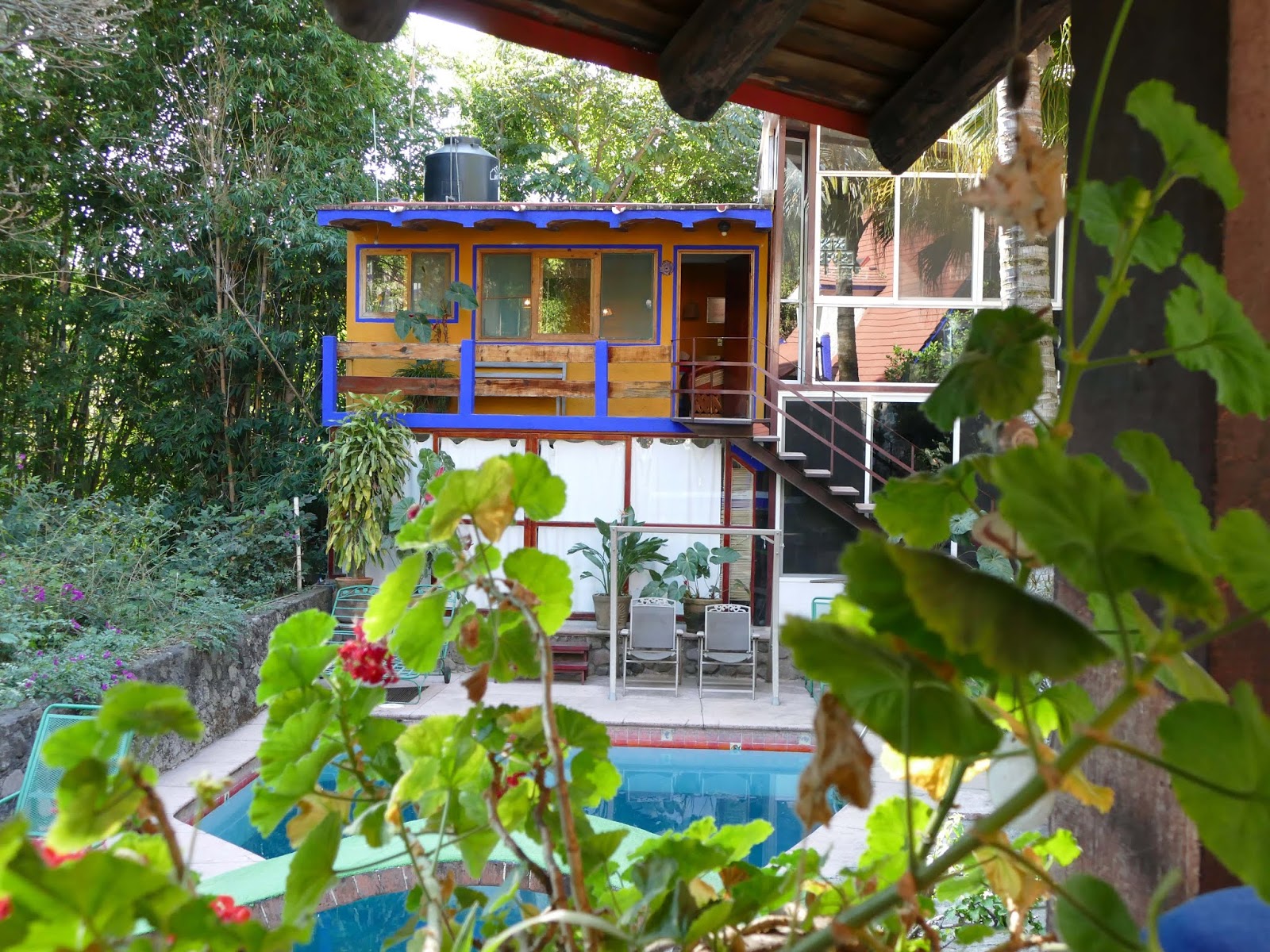
Neither the taxi driver nor I were quite certain this was the right place. But, I got out and he drove away while I knocked on two doors, not knowing which was the right one, and waited. Finally, a woman answered one of the doors and, with a smile, invited me in. Hesitantly, I entered a garage and followed her around a corner into … paradise. Remember in the Wizard of Oz when the movie shifts from black-and-white to Technicolor? Exactly!
Paradise found 
My home-stay paradise
My body was like a tightly inflated balloon that suddenly released all the tension I didn’t even know I was holding. Whatever else happened, I was safe in this beautiful garden with my own apartment looking out over a pool and surrounded by big trees.

In the days that followed, I would discover many things … about Cuernavaca … about my adopted family … about myself. 

Here are more pictures of the art-and-kindness filled paradise of the family abode they call La Morada:

Claudia and Paco, my beloved home-stay parents
My delightful ... and private ... nest


Wednesday, January 23, 2019

The Feast of the Three Kings

Cristina Potters
While I was in Cuernavaca, we celebrated the Feast of the Three Kings. I was going to write about it , but my new ... and amazing writer ... friend, Cristina Potters at Mexico Cooks! does such an incredible job, I'm just linking you to her article. As a teaser ... there's a baby Jesus and 40 tamales involved.

Click here for full article.  

"The most powerful English-language website in the world about Mexican cuisine is Mexico Cooks!, by the culinary writer Cristina Potters. She travels everywhere to investigate and bring the information to the world..." Culinaria Mexicana, http://www.culinariamexicana.com
That quote is just one of the many glowing reviews of Cristina Potter's amazing offering focused on the food, traditions and culture of Mexico. Cristina has lived in Mexico for forty years, speaks Spanish fluently and became a Mexican citizen several years ago. If you want to understand Mexico, her site is a great place to begin.


Saturday, December 22, 2018

Jerry Brown: Lake Chapala's Video Man

Jerry and Lori Brown
Moving to a new country, or even contemplating such a move, is somewhat like being hit with a tsunami of doubt and questions. Everything is different, and sometimes seems overwhelming. There’s a saying here at Lakeside that everything you want is here, it’s just a matter of finding it. That “finding” can be fun … or completely frustrating.

There’s a micro industry here built around helping people answer the many questions involved with this adventure ... Focus on Mexico brings groups of people here to give them an immersion into the area and a carefully crafted examination of the most pressing questions of where to live and how to deal with the unfamiliar rules and regulations of Mexico.

Several Facebook groups provide forums for people to ask questions about where to find things, how to deal with the immigration regulations, and what’s happening locally. (Ajijic Newbies also brings people together for periodic luncheons to help newcomers make friends and ask questions in person.)

And, there’s Jerry Brown’s videos, a visual encyclopedia of what’s going on in the Lake Chapala area.

Every week, Jerry, and his wife Lori, produce a video about life in the Lake Chapala area. Every week! A project that takes about 25 hours of his time. So far, they have produced almost 300 videos and have about 25,000 subscribers and over 3 million views.

My main question as we talked was “Why?” Part of their answer is presented in their YouTube Channel introduction … to help people know if moving to Mexico is right for them and to provide answers for the many questions involved.

However, as we talked, it became clear that there was more going on. There is an air of generosity that seems to hang over Lake Chapala. So many of the people I’ve met here have started or are avidly involved with projects that help people and animals here. Once a year, at the weekly lecture series called Open Circle Ajijic an engineer presents his almost twenty years of research and work to improve the water quality of the area (made a bit more dramatic when he drinks some of the water directly from the lake). A Canadian woman started and matches individual donors here and in the US and Canada with over 100 university students here. A Mexican folk art fan started the Feria Maestros del Arte 17 years ago and it has become the premier folk art fair here in Mexico.

The list of immigrant contributions to the area is long and impressive. From teaching English, rescuing street dogs, working in orphanages, building cleaner water systems in villages, organizing food donations for the poor, creating a summer art camp for kids, or bringing in cultural events for the local people, many people I've talked with here have reinvented their lives. 

People reinventing themselves.  

Jerry Brown had never done a video before he and Lori came to Ajijic. They have traveled extensively throughout their lives and wanted to help people better understand everything involved with moving to a new culture. When his son suggested making a video, the idea clicked. Now Jerry calls it “our Peace Corps” as they dedicate their time to answering questions and providing a constantly updated source of information for people contemplating moving here as well as all of us who have already made the move.

Jerry Brown’s travel videos are popular because they give a quick overview about the area and everything involved with immigrating here ... also because they are fun to watch. One of their videos shows them as lumps in bed, slowly coming out from under the covers ... fully dressed, of course. Their interaction in the videos is always fun to watch.

Lori is a delightful, energetic woman who escaped from Cambodia as a young mother and has an unsinkable enthusiasm for life. One of my favorite stories they told was about the time when Jerry was training for a marathon in Hawaii and … at the last minute … without any training ... Lori decided to do it also. And, she did. Her time was 8+ hours, but she finished and went on to do 14 marathons and 3 triathlons.

Here are a couple of examples of the videos they produce:

Click here to view.

Click here to view.


 And, the big question, of course, since we all see the ads that come with YouTube videos:

Does he make any money with these videos?

Jerry says he does ... and it works out to about $1.33 per hour ... USD.

Friday, December 14, 2018

Robina Nicol: homo artistican and maestra

"Love blooms in the garden" by Robina Nicol
by Joyce Wycoff

There are two types of artists: the ones born with paint brushes in hand and a waiting line of astonished adults ready to heap praises on their work … and the rest of us.

I’m not complaining. It’s just a fact that no one was any more surprised than I when I became a writer and an artist. There is a growing legion of us grateful late-bloomers. However, I’ve noticed that I still look at those life-long artists almost as if they are a different species … homo artisticans … born artists … “real” artists.

Painting by Robina Nicol
I met one of “them” at an art show here in Ajijic. We were both in the same show, both members of the same art society … but she was … well, different. Her abstract paintings were stunning, everything about her was color and style, and when we talked, she sounded like an artist with her international accent and her fluid conversation about her work. One thing she said shifted my opinion of her from “perfect, privileged artist” to “interesting person I’d like to know.”

Robina Nicol moved to Ajijic about six years ago from Canada, where she lived after emigrating from England as a child. For the past five years she has volunteered as an art teacher with the LCS Children’s Art Program and with the summer Art Camp. The painting that connected us is shown above and when I asked her about it, she talked about how much the children in the art program had affected her, inspiring her to paint with a looser style and bring more joy into her art.  She describes what she gains from her work with the children, “They have that joie de vivre spirit. They aren’t afraid to grow and try things."

Robina on couch painted by her.
Her humble, open approach to life and art drew me in, and a few weeks ago, she offered a class on “the rules of abstract art and how to break them." It was a painting class and I had spent years trying to paint before I fell in love with digital art. I had no intention of taking up painting again but I wanted to learn from Robina and she invited me to join the group. While I can’t claim she transformed me into a painter, I learned a lot with her and practiced what we call “art yoga” where I stretched my thinking which resulted in new work. 

However, what I truly loved was being in her incredibly beautiful space. Robina says her purpose in life is to make everything a little more beautiful than it was. Her home reflects that drive with its lime walls, turquoise walls, hand-painted furniture, large, colorful canvases, and a bathroom where the multi-colored wall was so luscious it made me want to lick it. (I didn’t.)
Hand-painted bed.
Cabinets Robina designed and painted (made by a carpenter).
Surrounded by the comfort and beauty of her home, Robina told me about her life. Growing up as a Brit in French Canada, she never felt like she fit in. While, her story confirmed that she was a “born artist,” perhaps it wasn’t a paint brush she was born with, but rather a handful of silk and a needle and thread. She began life as a designer, constantly drawing fashions, making clothes for her dolls, aprons for her dad’s work, her own clothes. At 10, she had saved up enough money for her first sewing machine and by age 12, when she was ready for a bra, she knew she could make it herself.

I hadn’t heard this story when I saw her in a coffee shop one day wearing a stunning lime green-outfit. When I commented on it, she said, “I made it.” I was gobsmacked. I have a history with sewing machines and making clothes … a frustrating, unfortunate history. When I expressed my shock, she said, “Oh, I was a designer.” To me, drawing a picture of a piece of clothing was a comprehensible action. Turning that drawing into a hand-embroidered, designer outfit was the work of the gods. It was that encounter that made me determined to know more about this multi-talented woman. (She is also a writer and has published a children's book about death.)

One of the fun things about being in Ajijic is hearing the life stories of people who live here. A thread that seems to run through a lot of those stories, such as Robina’s, is independence and curiosity. She dropped out of school at 15 1/2 and went to work. (At age 59, she went back to school to study journalism at Concordia University.) 

She spent most of her career working for McCalls' (the pattern company), traveling across Canada. After the McCalls job ended, she began a lingerie company, Lotus Wear, with a line called “Naughty Nothings.” She married twice and has a son who lives in the US.

"Flight to Freedom" by Robina Nicol
When I asked her how she got into painting, the story surprised me, although, by then, it shouldn’t have. In 1970, when the Apollo 13 mission developed problems that threatened the mission and the astronauts aboard, the world tuned in to watch. The images that flooded televisions everywhere sparked a need in Robina, a need to capture the feelings prompted by the images she was seeing. She rushed out to buy paints and brushes and has been painting since then. One of the frequent themes in her paintings is the Phoenix, an image of rebirth, that she says represents her own life of rising again and again after challenges and losses.

Robina says that one of the things she likes most about herself is “curiosity.” Curious about everything, she has studied palmistry and astrology and is currently studying 2500 year-old Babylonian astrology. She believes moving to Mexico gives people the freedom and time to become themselves, exploring things they may never have had time for before. Naturally, she says it in her own way ...

“Weave your own tapestry … and wear it!"  

The take-away from this lovely conversation with Robina was that it doesn't matter whether we are "born" an artist or a late bloomer, what matters is that we keep on learning and expressing and sharing who we are with the world. Thank you, Robina!